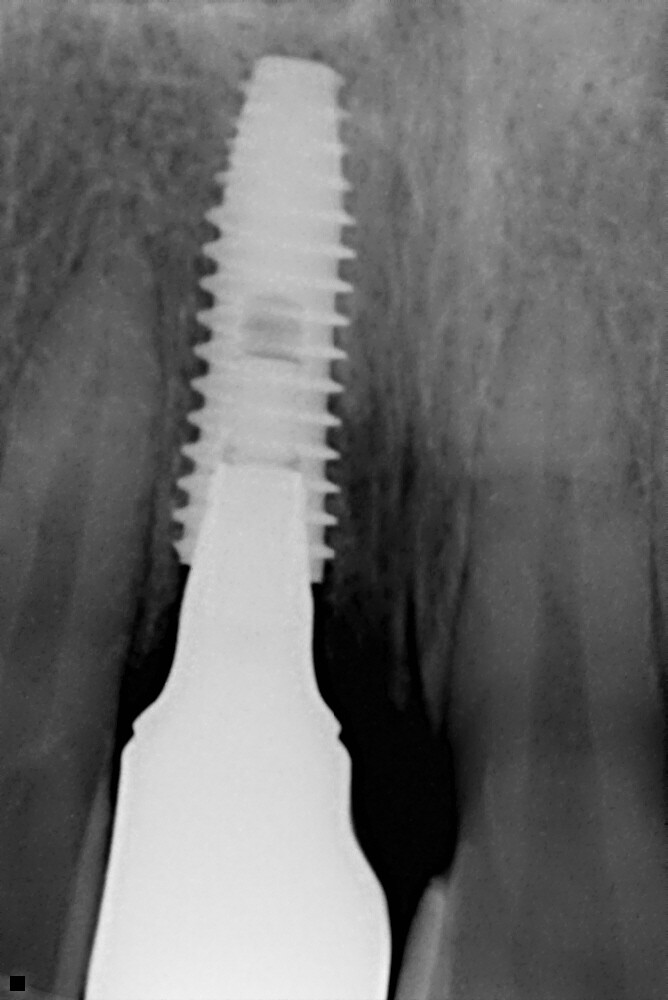
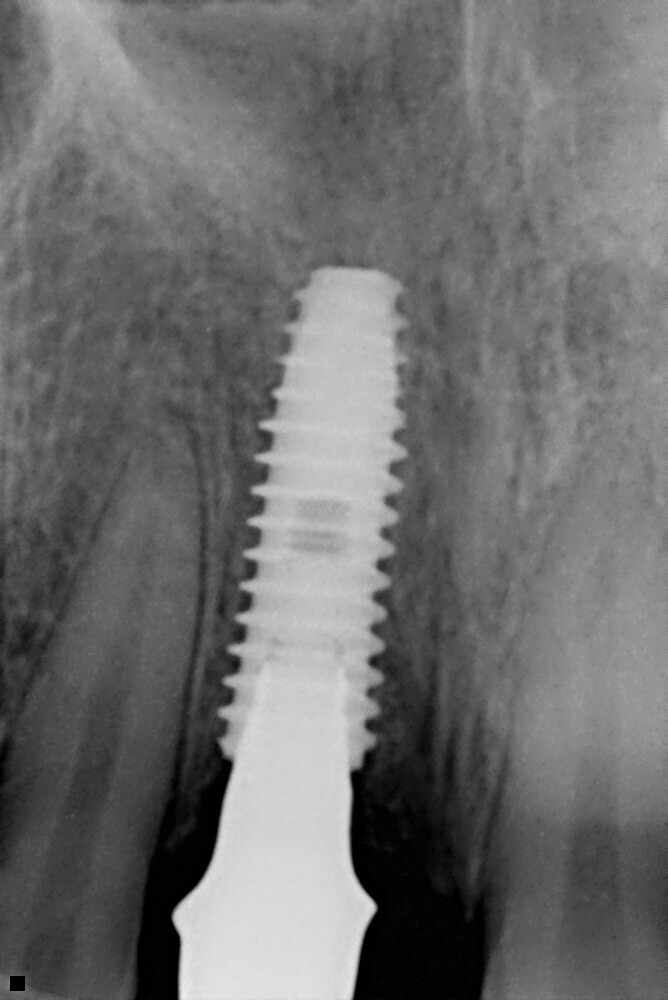
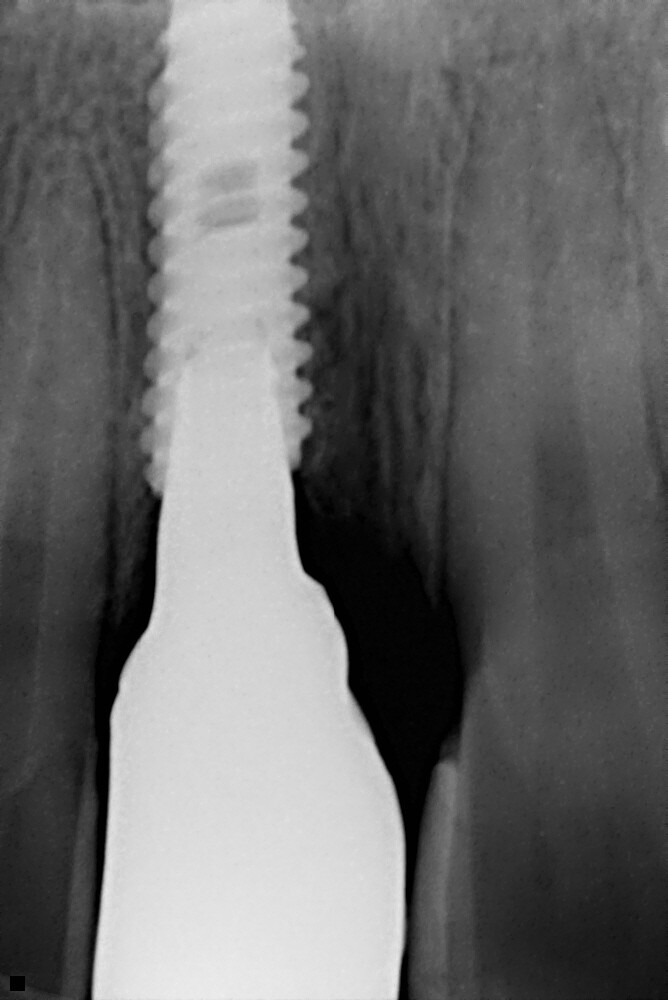
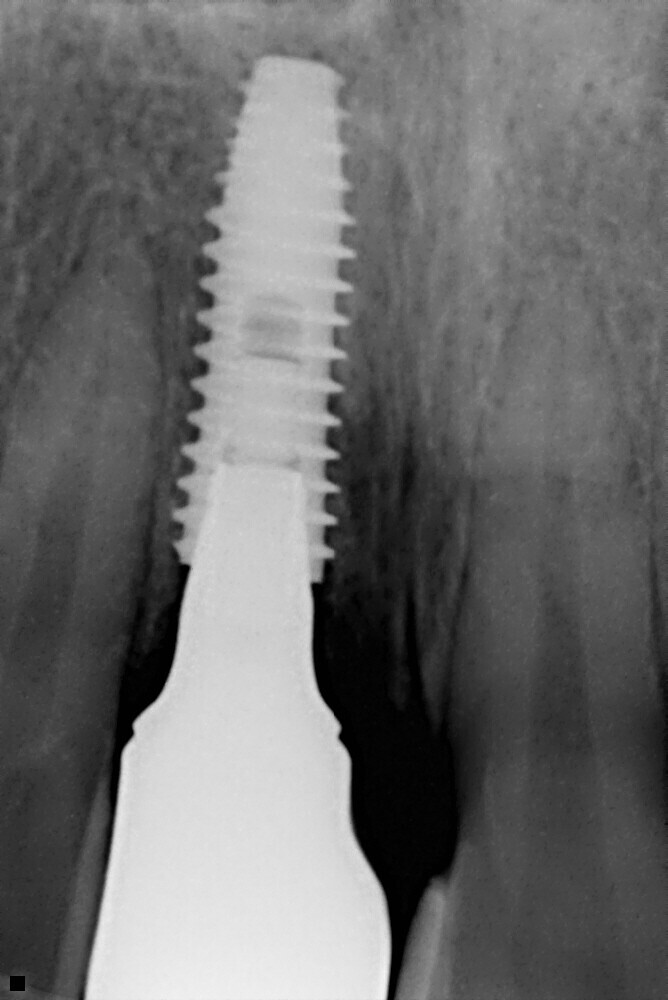
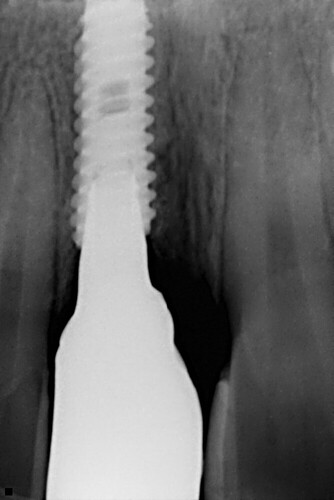
Hello. Yesterday I cemented zirconia crown over custom abutment. It was my first anterior implant case. While try- in the crown flushes with the abutment correctly. But the final Xray after crown cementation shows misfit the crown on the abutment. What to do now? And how to avoid this type of problem in future? Kindly guide.
Attaching here 3 photos. One is implant- abutment fit, one is try-in xray, and one final xray
If it is possible in this case and the screw channel is in a good position you could try a screw retained crown.
It appears at least radiographically that you cleaned up all the excess cement but it is possible you put too much cement in the intaglio of the crown which prevented it from seating crown all the way due to hydrostatic pressure. So less cement next time.
Since it is not a tooth and if floss still gliding under there smoothly although not ideal it probably will not be of any clinical concern. If it does cause any issues then you will have to make a new crown but most likely it will be fine. Good luck
Don’t do anything because it is fine. I imagine that you would be satisfied with marginal adaptation like this if it were a tooth born crown so why be so hard on yourself in this case… The best part is that the titanium abutment under the open margin has “ZERO”% chance of secondary decay!!!
Perio here…. If that is residual cement, and it appears as though there may be some, that you will likely see inflammation, deeper pockets, bleeding and later, if it left in place long enough, you may see bone loss and over time, peri-implantitis.
I’d get a Piezo or ultrasonic (with an appropriate tip for implant cleaning when needed,) followed by micro air anbrasion and clean that off ASAP. If cement isn’t removed than one may need to defer to an ER: YAG laser with tips to reach this for removal and it may involve flapping it for appropriate access.
Leaving cement around implants and their prostheses, is setting them up for failure. The longer it stays in place, the harder and more tenacious to remove. I’ve had to remove years-old retained excess cement that has led to peri-implant bone loss and have had to grind/polish it off prostheses. Naturally, that isn’t a good choice ordinarily because repetitive scaling or grinding on an implant or components will damage the titanium surface and invite titanium corrosion which is probably the leading cause of ultimate implant failure.
use screw-retained whenever possible and minimal cement (remember how tight fitting the components are— there isn’t soace for cement like a dental crown).
always send it to a periodontist if you see these things happening and we will do our best to help clean up ( and//or regenerate lost tissues) inflammation, peri-mucositis and peri-implantitis should they occur before you wind up losing too much bone and having the implant fail.
Don’t use too much cement and don’t leave it on without effectively removing it! It is a big deal ultimately/
Perio here too…Could you please point out this residual cement you are speaking about because I do not see it and apparently neither does “implantart” because he/she made reference to it in their post. I am not convinced that any is visible in this case and you might just be quoting bullet points from a textbook, all of which are true but likely don’t apply to this particular case.
Unless I am reading the original post wrong I think this is the final photo of the restoration “cemented”. While I do follow the logic of your post I don’t think it is relevant to this particular case.
when you cement the crown on to the abutment. did you let the patient bite on cotton roll? or did you use your fingers to hold the crown down? b/c anterior is at an angle. biting on cotton roll can slightly reposition implant crown from abutment causing your crown not to seat completely flush from the margins. IMO this would be the only possible reason why ur crown didn’t seat flush. for posteriors i’ll have pt bite on cotton roll, but for anteriors. i always push the crown down with my fingers and hold there. i don’t trust patients.
Another thing to consider is that the images are taken at different angles and the try-in/no cement image looks like it might have been taken with the patient in motion. It is possible that the crown fit exactly the same with and without cement and we are just making a big deal out of nothing because it is two images at different angles. In any event there does not appear to be any excess cement so no problem and nice job!!!
Scotty, from the way above inquiry was written, this X-ray appears to be the final one. It appears to me as though there may be residual cement/irregularity on the medial aspect of the crown/abutment area. As you point out, it can also be artifact due to patient movement.
Because I treat a good amount of peri-implantitis, I wanted to underscore why it is of importance to be removed, if and when present.
Sometimes being a periodontist can get in our way of thinking… I read the post to mean that the other photo, while not in order, was the cemented restoration and since the individual who posted this (smile_master) liked the post and did not correct me then I assume it is the final shot. It could be that you are a periodontist and see the worst in everything not done by a fellow gum gardener or that you are still hanging onto the superiority complex that is spoon fed to us during residency. Either way it is fairly common among newly trained dental specialists and one that in many cases naturally fades over time. I have been a periodontist for over 20 years and all that has gotten me is a few extra letters around my name which I choose to omit from any identifiers.
but honestly, i never do cement retained crowns. even if anterior and access hole on facial/incisal. i always do screw retained. pushing that crown on to abutment fighting gingiva is very difficult. sometimes the crown just doesn’t seat all the way to the margins. the gums are just in the way. implant abutment margin is not like a prep natural tooth. implant crown margins are way subG. whereas natural tooth crown margins are usually 1-2mm below the gums. less resistance during cementation.
I agree except that a custom abutment, when properly made, will have the crown margin in the appropriate location so I assume what you are referring to is a stock abutment. I always scan and send for custom milled abutments when doing cement retained and none of the problems that you describe are relevant. I would suggest that a true custom abutment be fabricated in the event a cement retained crown is indicated and not just the sawed off fixture mount on an Implant Direct fixture, which is actually marketed as a final abutment and works well as such in some circumstances.