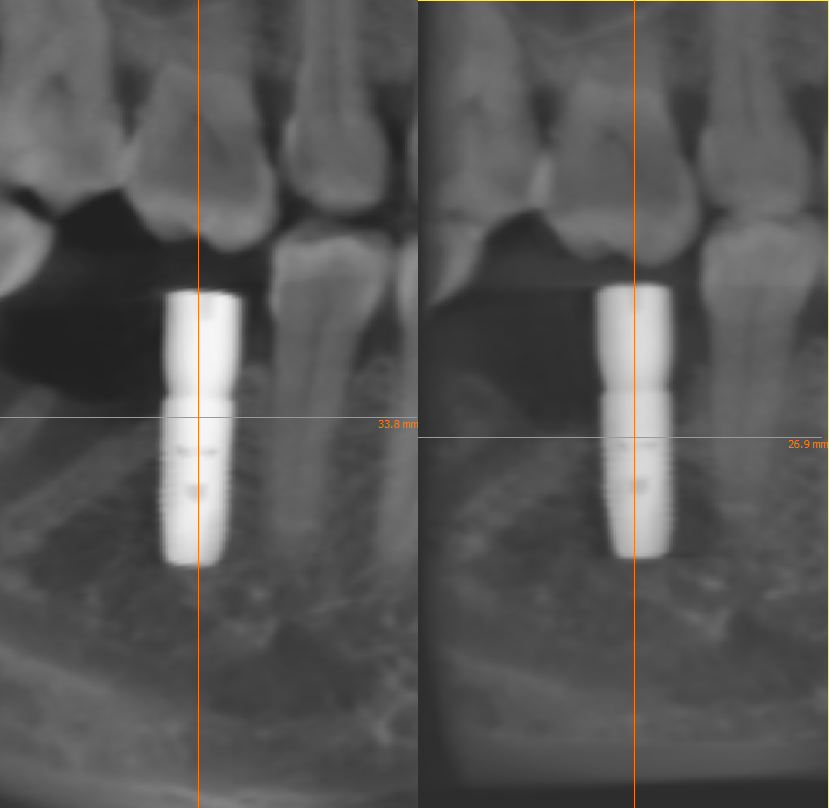
Tooth 46, not immediately implanted, bone type D2, implanted with an Astra EV 4.8x10 (straight). After osteotomy, during the final few millimeters of depth, a torque wrench was used with a force of approximately 25N. When the patient was 2mm away from the target depth, he suddenly experienced severe pain. I then administered inferior alveolar nerve block anesthesia, but the pain persisted. Finally, the expected depth was reached while accompanied by pain, and the torque wrench showed 45N. A healing abutment was then placed.
Within 24 hours post-surgery, the patient complained of sleeplessness due to increased pain at night, which was unresponsive to painkillers. The pain subsided after a few days, and there was no pain during the healing period.
Three months later, a CBCT scan showed extensive bone resorption in the implant neck cortex, as well as in the implant root and body. However, probing of the healing abutment showed no mobility. Finally, one month after crown placement, the implant loosened and fell out.
After detailed analysis, I believe the first reason for the failure is related to the severe pain. The patient experienced intense pain with only 25N of force during implantation; I have never encountered a similar situation before. The second reason might be that the 45N implantation torque was perhaps too high for a straight implant, as the Astra EV straight implant lacks healing space between threads.
I would like to ask if anyone has encountered a similar case?
We have all had failures and when it happens it is always great to try to assess why it happened. Sometimes you have a case that is very straightforward and no concerns and you have no idea why it failed and that happens too.
Based on your description and the fact it was D2 bone you probably had resistance to drilling the osteotomy and possible you overheated bone and that was the source of pain at the time and reason for failure as seen on the radiograph. It looks like you were no where close to the nerves that should not have been an issue. With no signs of infection
Sharp drills, lots of irrigation and pumping action should help prevent that.
The post op pain was probably a sign of that and the relatively rapid failure was indicative of that. Looks like you had primary stability but never transitioned to integration which is some evidence of overheated bone also but cannot be completely sure.
You insertion torque seemed well within normal. If you ever feel like insertion torque is a bit high you can always back the implant out a few turns wait a few moments and then retorque and the torque should be lower.
The procedure used cooled saline solution with enough pumping. I typically don’t spend more than 10 seconds per drill in the cavity. Furthermore, overheated shouldn’t cause immediate pain during surgery. The patient’s pain during the procedure was a sharp, throbbing pain, not a tolerable throbbing pain. I believe these conditions rule out overheated.
These are my opinions.
Addition, after implant removal, I performed local anesthesia and debridement. The patient still experienced pain in the mesial root apex region.
Sounds like you had all your bases covered with good technique. There also does not seem to be any pathology on the adjacent tooth. So that makes it difficult to figure out. Hopefully you have success when you place the the replacement implant and do not let a failure discourage you.
I have had similar failures in the past and like you I have tried to diagnose where I went wrong. I seriously doubt that 45Ncm insertion torque is excessive even for an Astra EV which is by definition a low insertion torque fixture… Today we have fixtures designed with aggressive threads for immediate load that are designed to be inserted at much greater torque so while that is a good point I doubt that excessive torque played a role in this. I have found that every time I have encountered this situation it has been in the mandible with dense bone and I believe that dense bone sucks for implants as it lacks vascularity. I think you just experienced a really unfortunate situation and if you continue doing this long enough might see it again but based on your critique of your own technique I would not suggest that you change anything. I would be curious to know how much blood came from this osteotomy because in my experience this has reared it ugly head when I drill a dry hole in dense mandibular bone… sort of like the dry socket equivalent in implant dentistry.
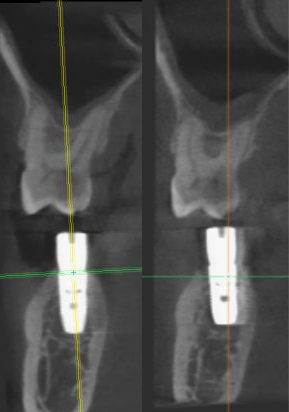
Thanks for your reply scotty, attached is a coronal view image. After consideration, it’s possible that the severe pain during surgery caused alveolar bone necrosis, resulting in loss of healing ability, but the cause of the pain is unknown.